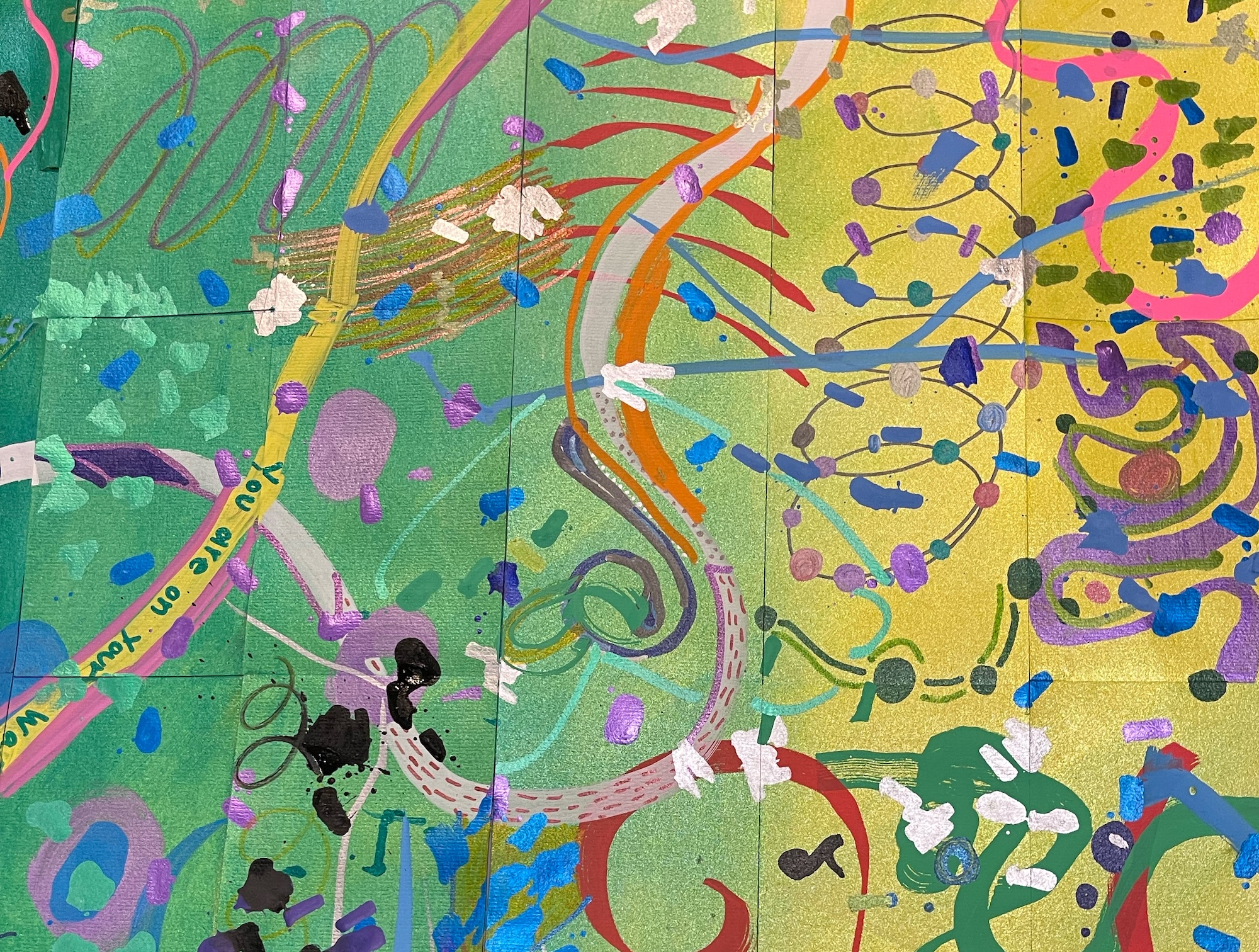
A participatory painting series in which participants respond to prompts by making abstract marks on a shared canvas.
Designed to be welcoming to people with any level of art experience, the activity reliably shifts a room from observation to participation, building collaboration, experimentation, and confidence within uncertainty in ways that translate directly to education, design, and futures work. What follows is a practical guide to running the experience, but if you’d like the origin story and the deeper “why” behind the work, learn more about the concept here:
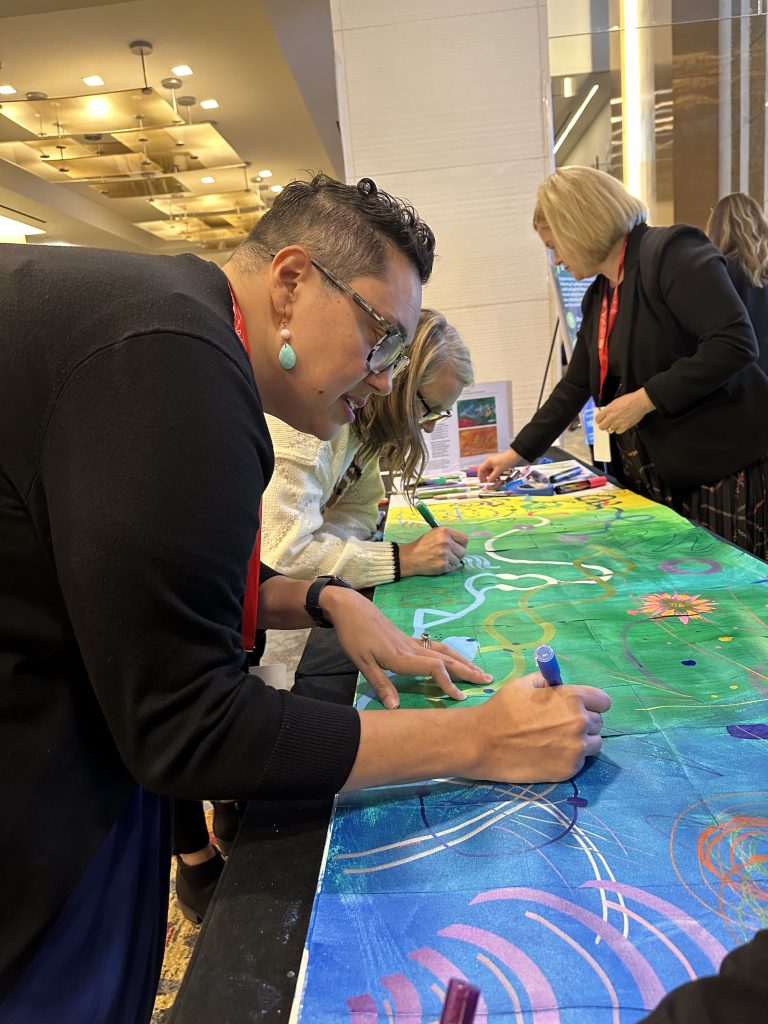
The goal of Confluence of Commands not technical mastery. Rather, it’s collective movement: a room shifting from observation to participation as people build on one another’s choices in real time. When you create the space for this work to come alive, you are facilitating two outcomes at once:
- a shared abstract canvas shaped by many hands, and
- a culture of permission—where people start quickly, contribute lightly, and help others begin.
Your job is to reduce friction at the start and protect emergence once the room takes over.
Things You’ll Need
This is not an exhaustive list of the supplies you may choose to use, but as you gather materials, you will want to include:
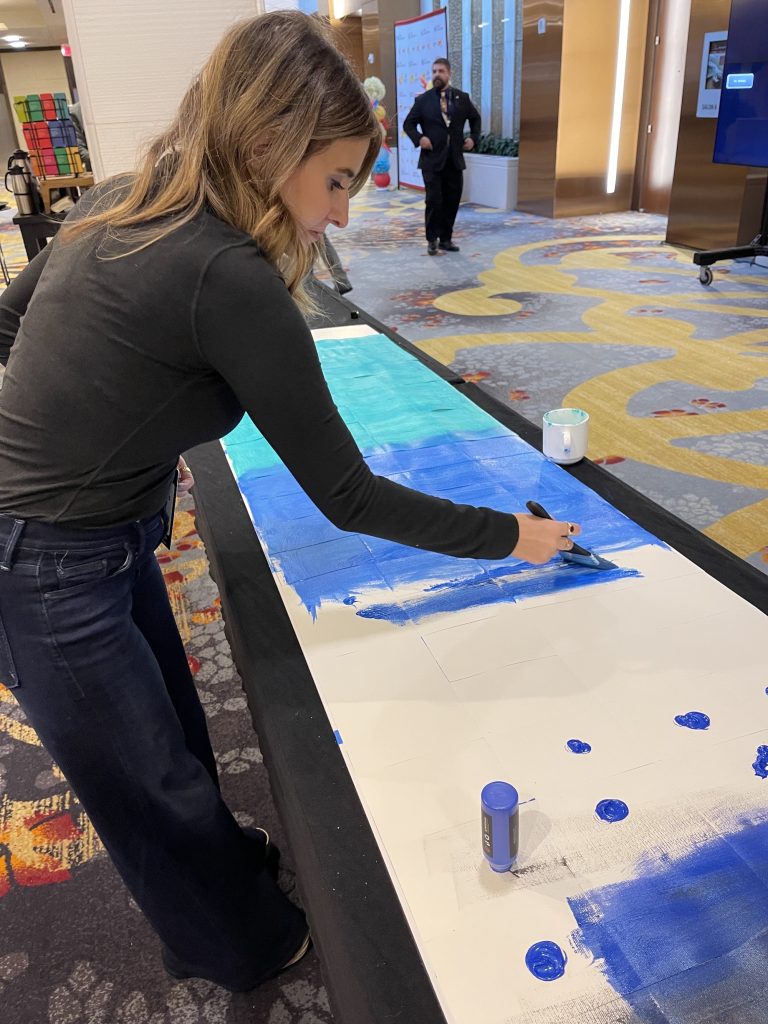
- A shared canvas prepared for group painting and later separation into individual pieces
- Acrylic paint and brushes to paint the canvas base
- Acrylic paint markers (varied colors + tip sizes) for drawing the prompts
- Minimal printed instructions placed beside the canvas
- Sleeves/mats for distributing pieces later
Note: The canvas build matters because it determines whether separation is clean and respectful of everyone’s work. The right method depends on your venue, size, and distribution plan.
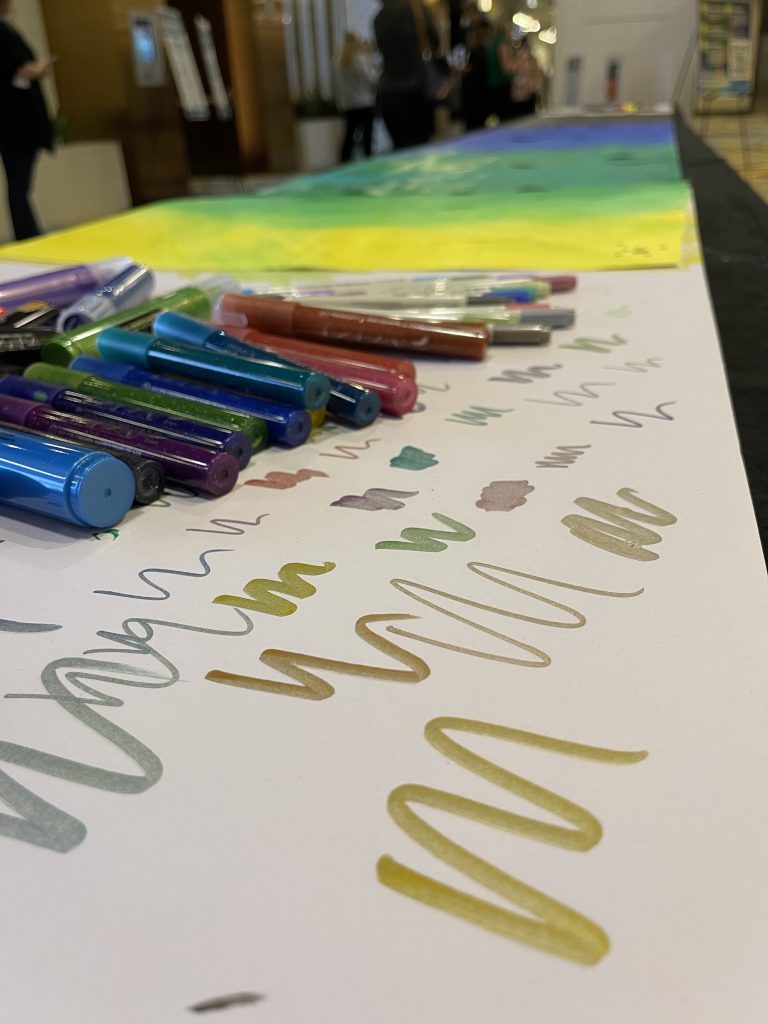
Facilitation Flow
1) Make starting effortless
Prompts should be visible, scannable, and easy to choose. Design as if most participants will not read a long doc or scan a QR code.
Optional one-line script:
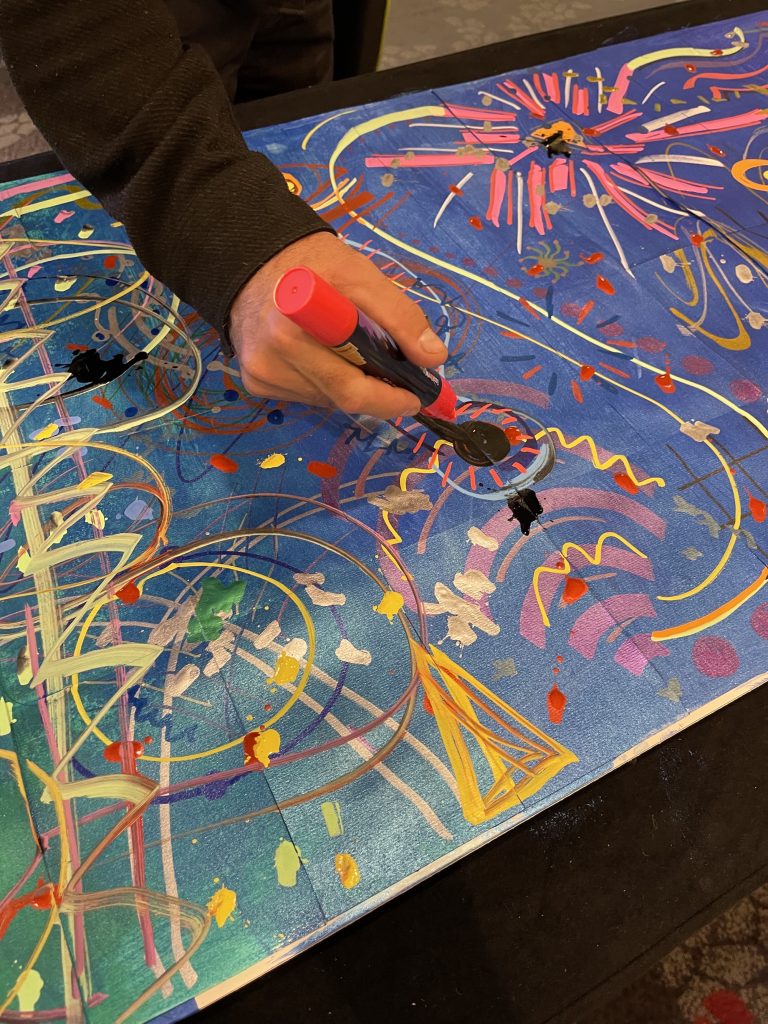
“Pick a prompt and make one abstract mark anywhere on the canvas.”
2) Seed the first marks
Help 2–3 early participants begin so others can learn by watching. Keep guidance permission-based: abstraction is allowed; one mark is enough; there is no wrong way.
3) Invite the hesitant
Treat hovering as participation-in-progress. Offer low-stakes entry:
- “Want a prompt suggestion?”
- “Start with a line or a pattern.”
- “It doesn’t have to look like anything.”
4) Shift from “start” to “respond”
Once the canvas has movement, encourage building with what’s already there:
- echo a color, extend a rhythm, add contrast, layer, connect.
5) Use micro-interventions, not speeches
Keep the room moving with small moves:
- create space if a crowd forms,
- redistribute markers,
- point newcomers to open areas,
- normalize small contributions.
Avoid extra reflection activities during a reception.
6) Let the room teach itself
When participants start guiding one another, affirm it. This is the handoff. Distributed facilitation is the inclusion mechanism.
7) Close with separation
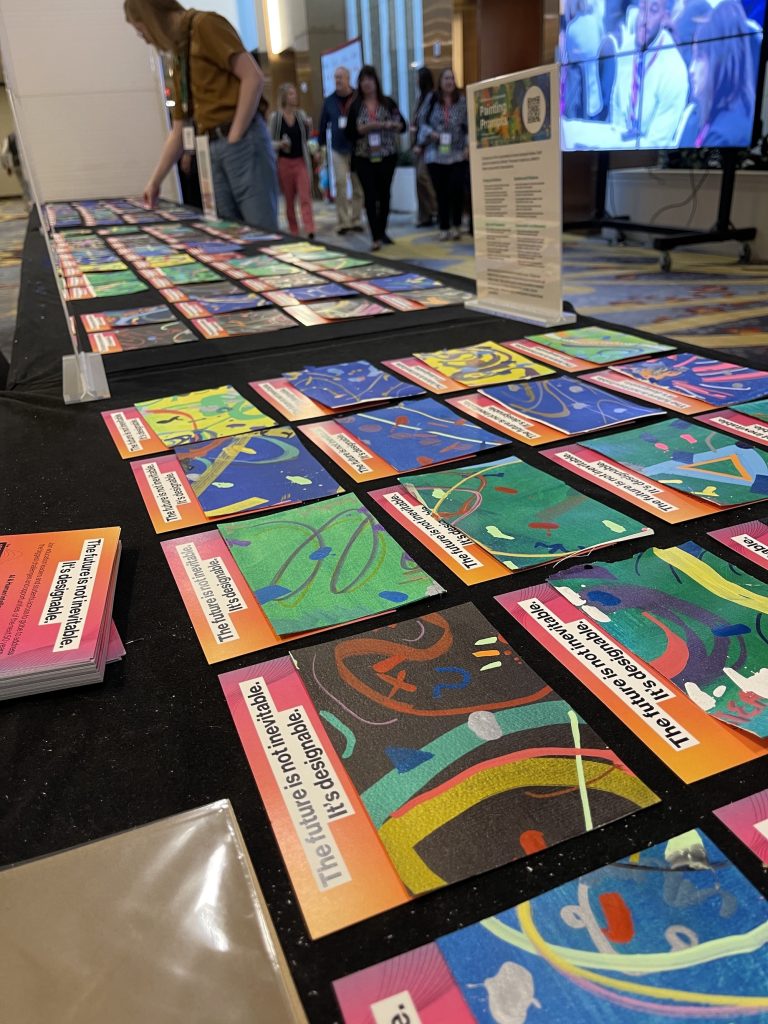
After the session, separate the canvas and distribute pieces as a fragment of the whole—an artifact of collective authorship.
Note: Plan your separation and distribution before the event; the details depend on how you built the canvas and how you want the ending to feel.
Remix With Care
Confluence of Commands is meant to be remixed. If you try a version of it in your own setting, I’d love to hear what you learn—especially what shifts when the activity meets a different community, purpose, or cultural context.
If you share your remix publicly, please credit the series and its creator:
Suggested Credit: “Confluence of Commands ([insert date of creation]) is a participatory painting series created by Angela Gunder.”
And if you’d like to bring a facilitated version to your community—or you’re curious how this kind of participatory art can support learning, design, or futures-oriented work—please reach out. I’m always glad to hear what people are building and to explore where I might be helpful.
_____
Image at Top: Section of “Confluence of Commands (II)” October, 2025.